UP TO THE MINUTE







Legal alert for Louisiana contractors
By Emma Peterson.
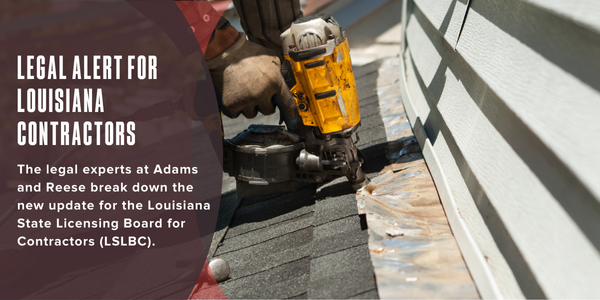
The legal experts at Adams and Reese break down the new update for the Louisiana State Licensing Board for Contractors (LSLBC).
In roofing and construction, licensure can be a complicated topic. There are a variety of different types of licenses, from state and local to commercial and residential. Each of these licenses has different requirements for qualifying and maintaining them, such as training, insurance, exams and continuing education. Further, licensure requirements can change as governing bodies adapt to an ever-evolving industry and world.
A prime example of this was the recent change the Louisiana State Licensing Board for Contractors (LSLBC) made for contractors who perform residential roofing work. As of January 1, 2026, you must have a specific classification (Residential Construction and Residential Roofing) to perform residential roofing work.
To help contractors understand what this means for their businesses, Trent Cotney, Susan N. Eccles and Christopher D. Joseph Jr. of the Adams and Reese law firm broke down the change in a recent article. One important factor they highlighted was what the new change considered a residential structure under LSLBC. They described the issue clearly so that contractors know whether or not they need to check their licensing:
“‘Residential structure’ means a building or structure that is used primarily for occupancy by a person as a residence. Such structures or buildings include but are not limited to single family dwellings, and duplexes which are not more than three floors in height and structures that are part of or adjacent to the building or structures to be used as a residence. A residential structure more than three floors in height may be built by a person holding a building construction and residential construction license.”
Learn more about Adams & Reese LLP in their Coffee Shop Directory or visit www.adamsandreese.com.
The information contained in this article is for general educational information only. This information does not constitute legal advice, is not intended to constitute legal advice, nor should it be relied upon as legal advice for your specific factual pattern or situation.
About the author

Emma is the senior content developer at The Coffee Shops and AskARoofer™. When she's not working or overthinking everything a little bit, she enjoys watching movies with friends, attending concerts and trying to cook new recipes.
Recommended For You

NCPI calls for clear limits on OSHA’s multi‑employer citation doctrine to strengthen worker safety and reduce litigation
Read More ...
Trent Cotney’s June 2026 legal updates
Read More ...
3 Things to Remember if OHSA Inspectors Arrive at Your Job Site
Read More ...
UP TO THE MINUTE




Comments
Leave a Reply
Have an account? Login to leave a comment!
Sign In