




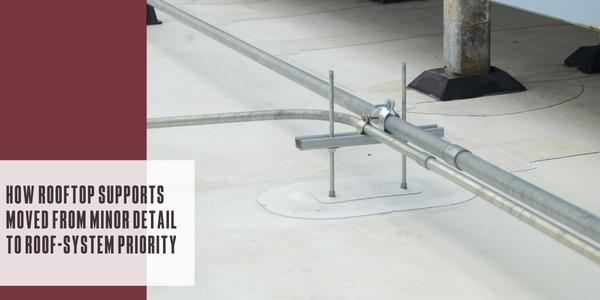
How rooftop supports moved from minor detail to roof-system priority
By Jesse Sanchez.
Mark Vargas explains why severe weather, seismic events and warranty concerns are changing how rooftop pipe and equipment supports are designed.
Rooftop pipe and equipment supports were once treated as low-risk details. In this episode of Roofing Road Trips®, Megan Ellsworth spoke with Mark Vargas, director of business development for AP Roof Services, the service side of Anchor Products, about why that mindset has changed and how the industry is rethinking securement. Mark works closely with contractors, buyers and manufacturers on the installation side of the U-Anchor and AP Solutions, helping ensure products are installed properly and in ways that support roof-system warranty requirements.
Q: What are rooftop pipe and equipment supports, and why do they matter?
“I was working for the non-penetrating companies that in the past that was acceptable, right?” Mark said. “When I went to work for them, there was woodblock that was supporting everything on the roof that was non-penetrating. There was plastic bases, was rubber blocks, counterweighted systems that if it was lightweight, they weren't too concerned about it damaging the roof system.”
Rooftop supports are used to hold piping, utilities and equipment in place on the roof. As Mark explained, older systems often relied on woodblocks, plastic bases, rubber blocks or counterweighted systems rather than attachments. Those methods were widely accepted because many rooftop items were considered lightweight or low risk, but that assumption began to change as the industry saw how unsecured supports could affect the roof system.
Q: Why were rooftop supports historically viewed as less critical?
“When I went to work for [Anchor Products], there were woodblocks that would be used in supporting everything on the roof that was non-penetrating. There were plastic bases, rubber blocks and counterweighted systems that if it was lightweight, they weren't too concerned about it damaging the roof system,” Mark shared.
Essentially, older support methods were often treated as routine roof accessories rather than engineered components. As Mark described, the focus was often on avoiding penetrations and relying on weight or simple materials, especially when rooftop utilities were considered light enough to stay in place without added securement.
Q: What exposed the weakness of older support methods?
Mark shared, “I think change happened mostly due to severe weather and seismic events. That's what exposed the weaknesses of the non-penetrating pipe supports. Pipes started sliding across the roof, where pipe supports or equipment supports would tip over.”
Severe weather and seismic activity changed how the industry viewed risk on the roof. When pipe and equipment supports shifted, tipped or became airborne, they created the potential for membrane damage, system failures and safety concerns, making securement a performance issue rather than a minor detail.
For contractors, the takeaway is clear that rooftop supports can affect roof performance, warranty protection and safety. As weather events and code expectations continue to shape specifications, securement is no longer an afterthought.
Listen to the entire podcast or Watch the conversation to learn more about the evolution of rooftop pipe and equipment supports!
Learn more about Anchor Products in their Coffee Shop Directory or visit www.anchorp.com.
Recommended For You

How smarter field fabrication improves productivity and quality
Read More ...
How contractors can strengthen marketing with AI
Read More ...
Why chalking on acrylic coatings should trigger action
Read More ...
UP TO THE MINUTE





Comments
Leave a Reply
Have an account? Login to leave a comment!
Sign In